
Every biological textbook praises DNA as the star of the show, yet three quieter players—structured water, the original life-plasm, and microtubules—have been choreographing the dance of life since the first tide pool shimmered in sunlight. Let’s lift the curtain on this subtle trio and see how they keep every cell humming.
1. Water That Behaves Like a Battery
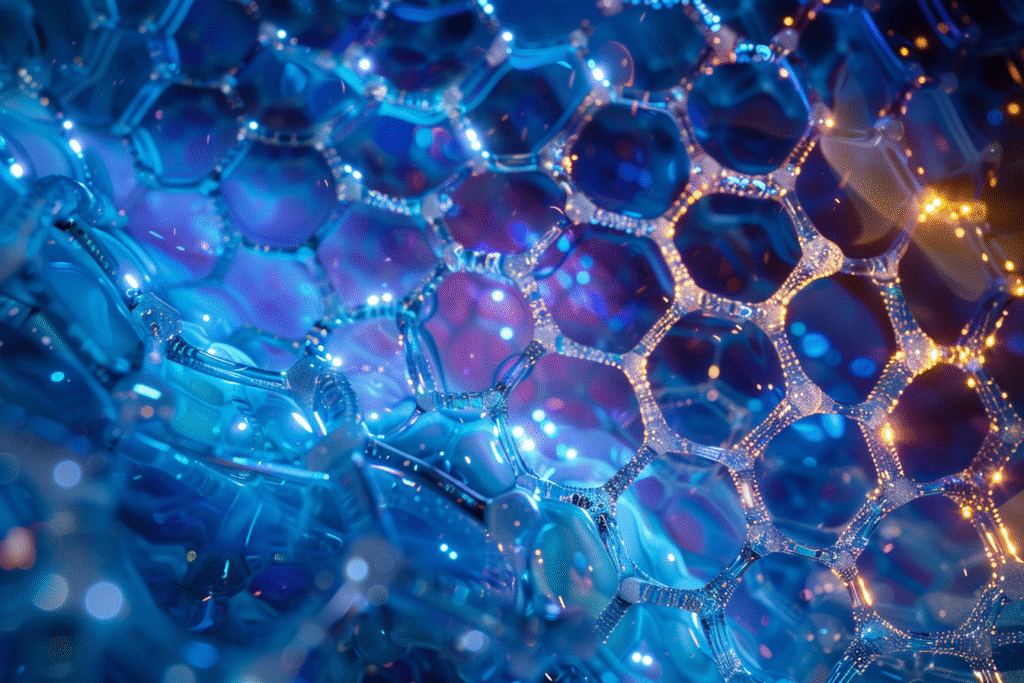
Most of us think of water as plain H₂O, but at hydrophilic (water-loving) surfaces it rearranges itself into “exclusion zones” (EZ water): hexagonal sheets that are denser, more ordered, and negatively charged. Picture a microscopic lattice that pushes protons aside, leaving behind a tiny wall of electrons—an all-natural capacitor.
Light feeds the lattice. Near-infrared grows it thicker, and ultraviolet light sharpens its negative charge even more, turning each EZ layer into a light-powered battery. A sunbeam striking a rock pool isn’t just warming the water, it is literally charging it.
2. The Arrival of Life Plasm
Urantia Book Paper 36 calls the seed of earthly biology the “original life plasm.” Think of it as a starter kit of proteins, lipids, and nucleic acids, delivered when Earth’s oceans had the right salt balance. These molecules were pre-wired to self-assemble only in a watery environment that could feed them energy—and the freshly charged EZ layers were perfect for the job.
Because EZ water naturally expels protons, it sets up gradients—the same kind of electrical slopes modern cells use to make ATP, fuel enzymes, and spark metabolism. The plasm didn’t invent its energy source; it plugged straight into water’s existing power grid.
3. Microtubules: Flexible Crystal Rails
Once cells appeared, they needed infrastructure. Enter microtubules: hollow cylinders made of α- and β-tubulin proteins. They grow fast at one end, shrink at the other, bend without breaking, and act as:
- Railways for kinesin and dynein “motor” proteins that haul mitochondria, vesicles, even chromosomes.
- Winches that pull DNA apart during cell division.
- Shock absorbers that brace a cell when it squeezes through tight spaces.
Look inside a microtubule and you’ll find a narrow column of ordered water—often EZ-like—running its length. In effect, each microtubule is a living coaxial cable: a protein shell insulating a negatively charged water wire.
4. How the Trio Works in Harmony
- Energy Coupling
EZ water’s surplus protons form natural gradients. Microtubule-bound proton pumps harvest those gradients to power transport inside the cell. The life-plasm’s earliest proteins likely did the same, turning light-fed water batteries into molecular motion. - Information Routing
Tubulin dimers can flip between shapes in trillionths of a second. Some researchers propose that the ordered water inside may help coordinate these flips, giving microtubules a role in cellular decision-making—perhaps even in neural signaling. - Structural Feedback
Mechanical stress thickens local EZ layers, altering charge density. That shift affects how quickly tubulin adds or peels away, letting microtubules reinforce areas under pressure. Water senses the squeeze, microtubules patch the wall, life stays intact. - Evolutionary Flexibility
Variations in tubulin subtly change the charge landscape of the lumen. Over time, organisms could fine-tune microtubule behavior—rock-steady in a long axon, hyper-dynamic in a dividing embryo—without rewriting the whole blueprint.
5. Why Ultraviolet Matters
While infrared light is best at expanding the EZ zone, ultraviolet light intensifies its negative charge. Early Earth, awash in UV before a thick ozone layer formed, might have enjoyed extra-energized water batteries. That extra voltage could have jump-started the very first metabolic cycles encoded in the plasm.
Today, brief sun exposure still re-charges the EZ layers in your tissues. That “refreshed” water, in turn, supports microtubule transport, mitochondrial output, and overall cellular vitality. A reason to enjoy natural light—and hydrate—every day.
6. Modern Echoes of an Ancient Alliance
- Health and Healing
Dehydration or long periods away from natural light shrink EZ layers, dull proton gradients, and slow microtubule traffic, leaving us fatigued. Proper hydration and sunlight help reboot the system our cells expect. - Medical Frontiers
Anaesthetics bind inside neuronal microtubules. Some scientists suspect they disrupt water-microtubule coupling, dimming consciousness. Understanding that interplay could inspire gentler anaesthetic drugs—or novel therapies for neurodegeneration. - Origin-of-Life Research
Lab-made protocells show that peptide tubes plus structured water can crawl toward light, powered only by EZ charge. These simple systems hint at how the original plasm exploited water’s electrical quirks long before complex enzymes evolved.
7. A Hydroview Takeaway
Imagine a river delta:
- The water is every channel, quietly building banks of negative charge wherever light falls.
- The microtubules are reed rafts, forming and reforming to ferry resources.
- The life-plasm is fertile silt, carrying the seeds of endless possibility.
None can flourish alone, but together they turn sunlight, minerals, and a bit of chemical curiosity into the miracle we call life.
So drink clean water, step into the sun, and marvel at the invisible power grid humming inside every cell. Want to dive deeper into the flow between science and spirit? Visit wisdomaccelerators.com and hydroviews.com for more Hydro-infused insights.