
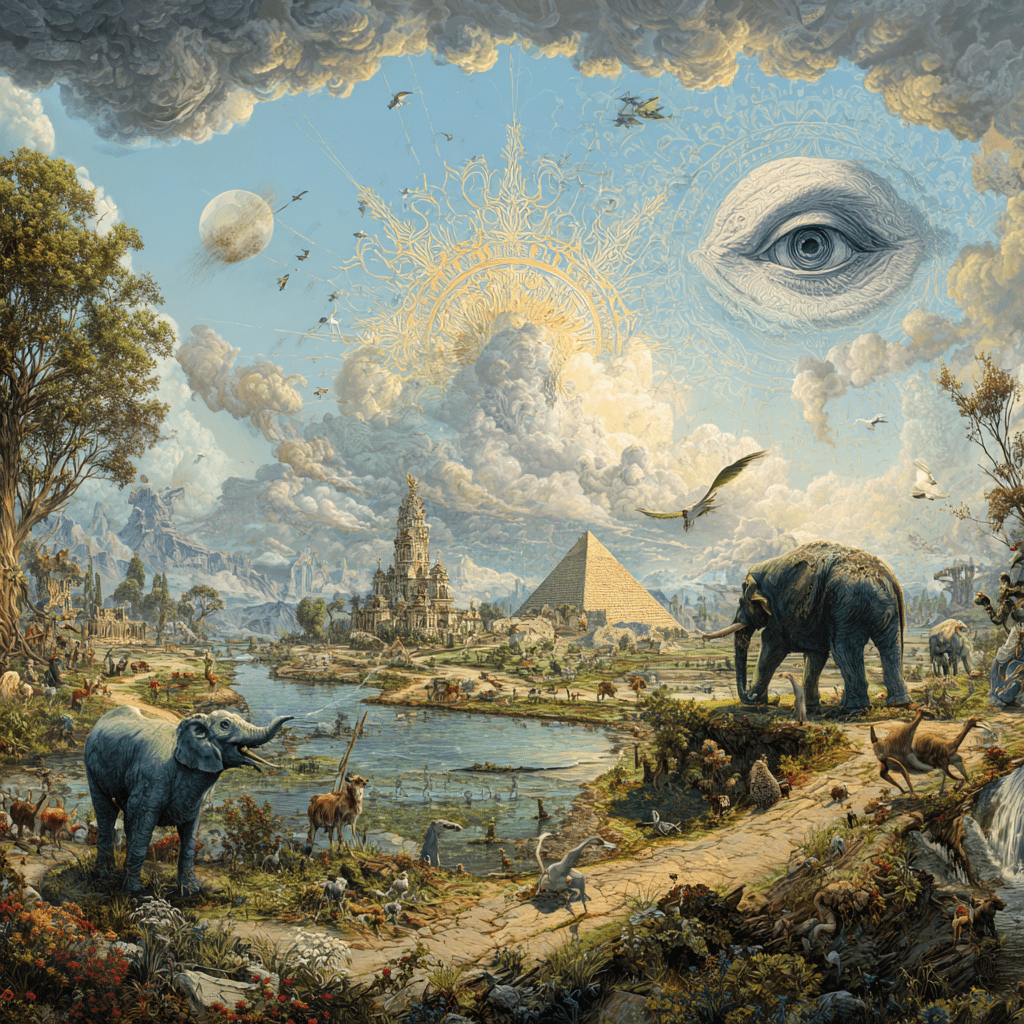
In the ever-deepening conversation between science and spirituality, few debates have stirred more passion than the one between evolution and intelligent design. One side champions natural selection and random mutation as the engines of life’s diversity. The other argues for a purposeful, guided creation that reflects a higher intelligence. But must these views be at odds? What if both contain pieces of a larger, more beautiful puzzle—a puzzle hinted at not only in modern science and spiritual experience, but profoundly illuminated in The Urantia Book?
Let’s explore the core distinctions and surprising harmonies between evolution and intelligent design, all while weaving in a third thread: a spiritual cosmology that invites deeper understanding.
Evolution: The Dance of Time and Chance
Evolution, as taught in mainstream biology, rests on a foundation of naturalism. Organisms evolve over vast spans of time through a process of genetic variation, natural selection, and adaptation to changing environments. It’s elegant in its simplicity and staggering in its explanatory power.
From a scientific standpoint, evolution has explanatory strength for the fossil record, the genetic code, and the unity and diversity of life. Yet, to the spiritually inclined, it can sometimes feel… impersonal. Where’s the soul, the spark, the sacred intent?
To many, evolution feels like a story without a storyteller.
Intelligent Design: The Signature of Mind in Matter
Intelligent design, by contrast, suggests that certain features of life and the universe are best explained by the action of an intelligent cause rather than undirected processes. Proponents point to the fine-tuning of the cosmos, the complexity of DNA, and the interdependence of biological systems as signs of a designer’s fingerprint.
But critics rightly ask: Is this science or theology in disguise? If we cannot test or measure the designer, how does this differ from creationism?
Still, intelligent design appeals to those who believe the universe has purpose, direction, and meaning. And perhaps it’s asking the right kind of question, even if not always in the right format.
The Urantia Book’s Perspective: Cosmic Evolution with Divine Oversight
Enter The Urantia Book, a revelatory text that bridges the chasm between evolution and intelligent design by proposing a third way: guided evolution under the oversight of celestial beings operating under universal law.
According to The Urantia Book, life on Urantia (Earth) was not an accident, nor was it conjured fully formed. Instead, it was seeded by Life Carriers, a specific order of spiritual beings entrusted with catalyzing evolutionary processes across the universe. These Life Carriers work in harmony with natural laws, not in contradiction to them. Life is “evolved,” yes—but that evolution is guided, fostered, and even lovingly curated over eons.
This model honors both the creative intelligence behind the universe and the gradual unfolding of biological complexity. It does not pit science against spirit; it marries them.
Here’s how the comparison unfolds:
| Aspect | Evolution (Scientific) | Intelligent Design | The Urantia Book |
|---|---|---|---|
| Mechanism | Natural selection, mutation, time | Intervention by higher intelligence | Evolution guided by Life Carriers and universe laws |
| View of Life | Random emergence, no inherent purpose | Purposeful creation, possibly sudden | Purposeful unfolding of life through evolutionary means |
| Role of God/Spirit | Not acknowledged | Implied or central | Integral, but operating within universal patterns |
| Compatibility with Science | Fully scientific | Questioned by many scientists | Seeks harmony between science and spiritual insight |
| Origin of Species | Gradual evolution from common ancestors | Possibly independent creations | Evolved through seeded life and intelligent guidance |
Water, Spirit, and the Memory of Life
In both science and spiritual philosophy, water plays a central, almost mystical role. Gerald Pollack’s research into the fourth phase of water suggests a crystalline, coherent structure capable of storing energy and possibly even information. The Urantia Book portrays water as the cradle of life, infused with divine energy and life force.
What if the structure of water itself—so crucial in the emergence of cells—was part of the intelligent scaffolding through which evolution occurred? What if the Hydroview we’ve been exploring—the lens through which life, spirit, and science meet—isn’t poetic metaphor alone, but the very mechanism through which spirit embraces matter?
Reconciling the Two Through Wisdom
When we let go of binary thinking, we find that evolution and intelligent design may both reflect universal truths:
- Evolution shows the how—the observable mechanisms, the story of slow emergence and adaptation.
- Intelligent design asks the why—the philosophical question of meaning, intent, and origin.
- The Urantia Book offers the who and where—tracing the arc of spiritual agency operating through physical processes, from the Universal Father to the Life Carriers.
Science gives us telescopes. Religion gives us purpose. Revelation, when genuine, helps us connect the stars to the soul.
Final Thought: An Invitation to Hydroview
Rather than choosing sides, perhaps we are being invited to cultivate a Hydroview—a flowing, integrative vision that honors the structure of science, the inspiration of spirit, and the deep intuitive knowing that we are not accidents.
As The Urantia Book reminds us, “Science is the source of facts, and mind can coordinate these facts, but only wisdom and spiritual insight can interpret their meaning.”
So let us not ask whether life was designed or evolved, but rather:
How did the design evolve?
And who whispered life into the waters of time?