
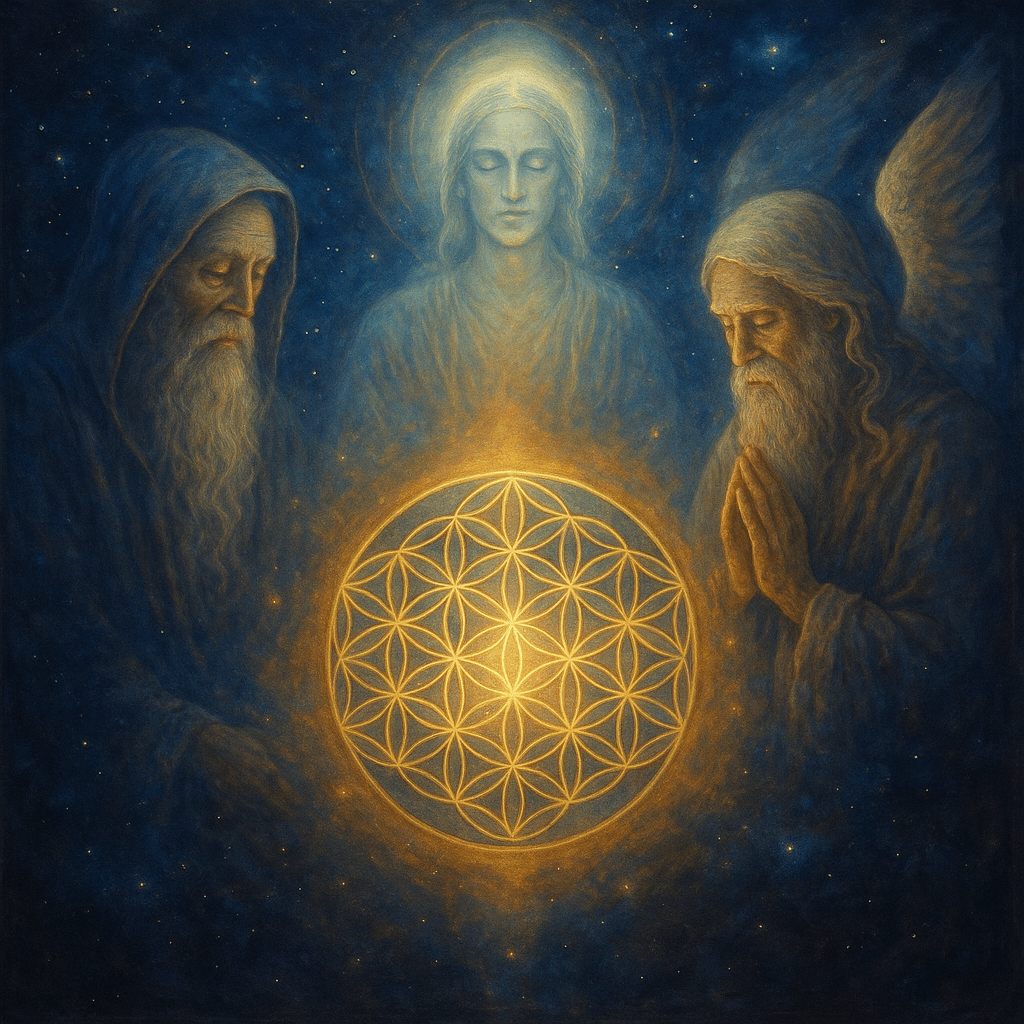
In the vast landscape of spiritual literature, few names evoke as much intrigue as Metatron, the enigmatic archangel and scribe of heaven. Revered in mystical Judaism and echoed in modern esoteric teachings, Metatron is regarded as a divine intermediary, a keeper of sacred geometry, and a guide for spiritual ascension.
And yet, when we turn the pages of The Urantia Book, a profound and complex cosmological revelation, we find no mention of Metatron by name. This absence invites reflection, not just on the character of Metatron, but on the broader question: What is included in the Urantia teachings, and what is left unsaid?
The Silence Around Metatron
In Jewish mysticism, Metatron is believed to be the transformed form of Enoch, who was “taken up” and made an archangel. He is often associated with the highest realms of divine intelligence, overseeing the Tree of Life and the Akashic Records. His image appears frequently in Kabbalistic texts, where he is called the “Prince of the Divine Presence” or the “Scribe of God.”
This deeply mystical and symbolic figure is conspicuously absent from The Urantia Book, a text that claims to map the administrative, spiritual, and evolutionary structure of the universe. While the Urantia narrative goes into extraordinary depth about archangels, Thought Adjusters, Seraphim, and the Melchizedek order, it sidesteps many historical religious figures outside its specific cosmological framework.
Could Metatron be one of the “names” of a being known by another term in the Urantia cosmology? Or is this silence a signpost pointing us to look beyond literal labels and explore deeper symbolic truths?
Celestial Beings in The Urantia Book
Though Metatron is not named, The Urantia Book offers a rich vocabulary of celestial beings:
- Archangels: Described as powerful coordinators of divine justice and evolutionary progress. They work under the guidance of higher spiritual authorities like the Ancients of Days.
- Thought Adjusters: These are fragments of God that indwell the human mind, echoing what some mystical traditions may interpret as divine messengers or guides, similar in function to Metatron’s reported role as a spiritual bridge.
- Melchizedeks: A unique order of beings who function as teachers and administrators in the universe, reminiscent of the wisdom-sharing role attributed to Metatron in sacred geometry and mystical systems.
Is Metatron a Symbol, a Being, or Both?
From the perspective of sacred geometry and metaphysical science, Metatron represents more than just a celestial entity—he becomes a symbol of divine structure, intelligible creation, and the mathematics of consciousness.
Figures like Gregg Braden and Drunvalo Melchizedek speak of Metatron’s Cube as a template for all matter and form, a divine signature in the architecture of reality. This resonates deeply with Einstein’s belief in a rational, comprehensible universe—and even with The Urantia Book’s insistence on cosmic order and intelligent design.
So while the Urantia Revelation omits the name Metatron, the essence of what Metatron symbolizes—the bridge between spirit and form, the scribe of divine intelligence, the guide to inner ascension—is deeply present.
The Path Forward: Synthesis Over Division
Rather than see this omission as a contradiction, we might embrace it as an invitation to synthesize wisdom from diverse traditions. The Urantia Book offers a structured celestial cosmology; the mystical traditions present an intimate, symbolic cosmology. Together, they can enhance our understanding of our place in the universe.
As A Course in Miracles teaches: “A universal theology is impossible, but a universal experience is not only possible but necessary.”
Perhaps Metatron is not missing from the Urantia cosmology after all—perhaps he lives in the symbols, the functions, and the divine intentions scattered throughout its pages.
What do you think?
Is the omission of certain mystical figures in The Urantia Book a challenge to move beyond literalism and toward spiritual intuition?